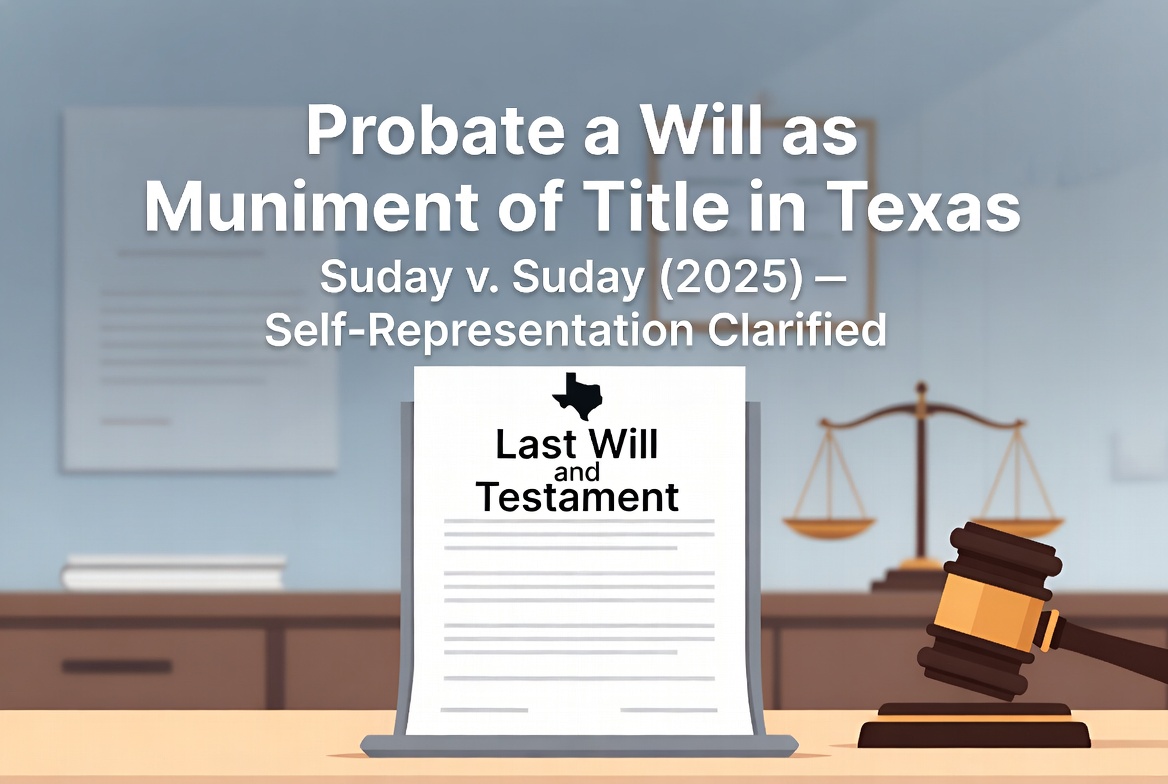
 Can You Probate a Will as a Muniment of Title in Texas Without an Attorney?
What the Texas Supreme Court’s Decision in Suday v. Suday, 716 S.W.3d 586 (Tex. 2025) Means for You
Lunbing C. Altaffer
At Altaffer & Chen PLLC, we help Texas families navigate probate matters efficiently and with confidence. One of the most common questions we receive is whether someone can handle a probate application pro se (without a lawyer)—especially when using the streamlined “muniment of title” process under Texas Estates Code Chapter 257. The short answer: In very limited circumstances, yes—but the Texas Supreme Court’s 2025 decision in Suday v. Suday clarifies exactly when self-representation is allowed.
Understanding Muniment of Title: A Simple but Precise Tool
Probating a will as a muniment of title is Texas’s streamlined option for transferring real estate (and sometimes personal property) when formal administration of the estate isn’t needed. No executor is appointed, no ongoing court supervision occurs, and the court order plus the will itself become the legal “muniment” (evidence) of title that can be recorded in the county deed records.
To qualify, the estate generally must meet these requirements:
- The will must be valid and properly executed.
- There are typically no unpaid debts, other than any debt secured by a lien on real estate.
- Administration is unnecessary because the will clearly disposes of the property.
Many families assume this simplicity means they can file the application themselves. Self-representation is allowed only when you are truly representing only yourself—most often when you are the sole beneficiary under the will, serve as the named executor, and the estate has no unpaid debts (other than any debt secured by a lien on real estate). In those narrow cases, you are effectively handling your own interests.
The Game-Changing Suday v. Suday Decision
Prior to 2025, many Texas courts followed a strict general rule: an executor (even a non-lawyer family member) could not represent the estate pro se because they would be acting in a fiduciary capacity for others, which constitutes the unauthorized practice of law.
In Maryvel Suday and the Estate of Olga Tamez de Suday, Petitioners, v. Jesus Lozano Suday, decided by the Texas Supreme Court on June 27, 2025 (No. 24-1009), the Court held that “an executor may represent the estate pro se when she is also the sole beneficiary of the estate[.]” In this case, Maryvel Suday was both the independent executor and the sole beneficiary of her mother’s estate. She became involved in litigation challenging aspects of her parents’ prior divorce and property division. Lower courts had barred her from proceeding without a lawyer, citing the traditional prohibition on executors appearing pro se.
The Texas Supreme Court reversed in a unanimous per curiam opinion. Key holdings and reasoning:
- When an executor is also the sole beneficiary (and, on the facts presented, no creditors or other stakeholders are affected), the executor is not truly representing third-party interests.
- Instead, she is effectively asserting only her own personal rights. This aligns with Texas Rule of Civil Procedure 7 and constitutional principles protecting the right to self-representation.
- The Court assumed without deciding the validity of the broader “no pro se executors” rule but created a clear exception for sole-beneficiary situations.
- Result: The Court remanded the case, allowing Maryvel Suday to proceed pro se.
The decision is narrow under the circumstances of this case, but it is powerful. It is powerful because the ruling aligns with the reasoning in Ex parte Shaffer, the decedent's widow sued the estate's executor for breach of fiduciary duty. 649 S.W.2d 300, 302 (Tex. 1983). In that case, the Court held that “ordering a party to be represented by an attorney abridges that person's right to be heard by himself” and that if the “lack of an attorney was being used to unnecessarily delay trial or was abusing the continuance privilege, the proper action would have been to order him to proceed to trial as set, with or without representation.” If you are the only person who stands to gain or lose from the probate outcome, the court cannot automatically dismiss your filing simply because you lack an attorney.
Why Most Families Still Choose an Attorney
Even after Suday, the practical reality in Texas probate courts remains cautious:
- County-specific policies vary. Many probate courts (including in Harris, Dallas, Bexar, and Denton counties) have standing orders or local rules that discourage or scrutinize pro se filings. Clerks may reject incomplete applications or require proof that you truly qualify as the sole beneficiary with no complicating factors.
- The process is deceptively technical. The application must include specific statutory recitations, an accurate list of all property, proof of the will’s validity, and affidavits addressing Medicaid recovery claims. One missing exhibit or incorrect legal description can delay recording the order for months.
- “Sole beneficiary” is a high bar. If there is even one other heir, a potential creditor, or a dispute over the will’s validity, the Suday exception does not apply. You would then be representing the estate’s interests, which requires a licensed attorney.
- Pro se litigants often struggle. As the Supreme Court itself noted in Suday, while the law now permits self-representation in qualifying cases, the procedural and evidentiary demands of probate can still trip up even well-intentioned families.
Keep in mind that a small drafting error in a muniment-of-title application can lead to rejected filings, additional hearings, or—worst case—having to restart the entire probate process as a full administration months later.
The Smart Choice: Experienced Counsel for Peace of Mind
Whether your situation qualifies for the Suday exception or involves multiple beneficiaries, debts, or complex assets, partnering with a knowledgeable Texas probate attorney delivers measurable value:
- Faster court approval and clean title transfer.
- Protection against unintended tax or creditor issues.
- Comprehensive review of all estate assets (including those you might overlook).
- Guidance on whether muniment of title is even the right tool—or if a small-estate affidavit or full probate would serve you better.
Bottom line: The Texas Supreme Court’s decision in Suday v. Suday is a welcome clarification that expands access to justice for simple, single-beneficiary estates. But it does not eliminate the complexity or the risks of going alone.
If you have a loved one’s will and are wondering whether you can (or should) probate it as a muniment of title without an attorney, we invite you to schedule a confidential consultation. Our team will review your documents, explain your options under current Texas law (including Suday), and provide a clear, flat-fee quote for handling the matter efficiently.
DISCLAIMER
The information in this blog is provided for general educational and informational purposes only and is not intended as legal advice. Laws change frequently, and this content may not reflect the latest developments.
Viewing or reading this blog does not create an attorney-client relationship with Altaffer & Chen PLLC. You should consult a licensed attorney in your jurisdiction for advice tailored to your specific situation. Do not rely on this information to make legal decisions without professional guidance.
Neither Altaffer & Chen PLLC nor Lunbing C. Altaffer makes any warranties regarding the accuracy or completeness of this content and expressly disclaims all liability for any reliance on it.
4/13/2026
Contact Information:

4054 McKinney Ave
Suite 310
Dallas, TX 75204
Tel: (972) 234 3633
Fax: (972) 947 3663
Email: info@altafferlaw.com
WeChat ID: altafferchen