Lunbing C. Altaffer
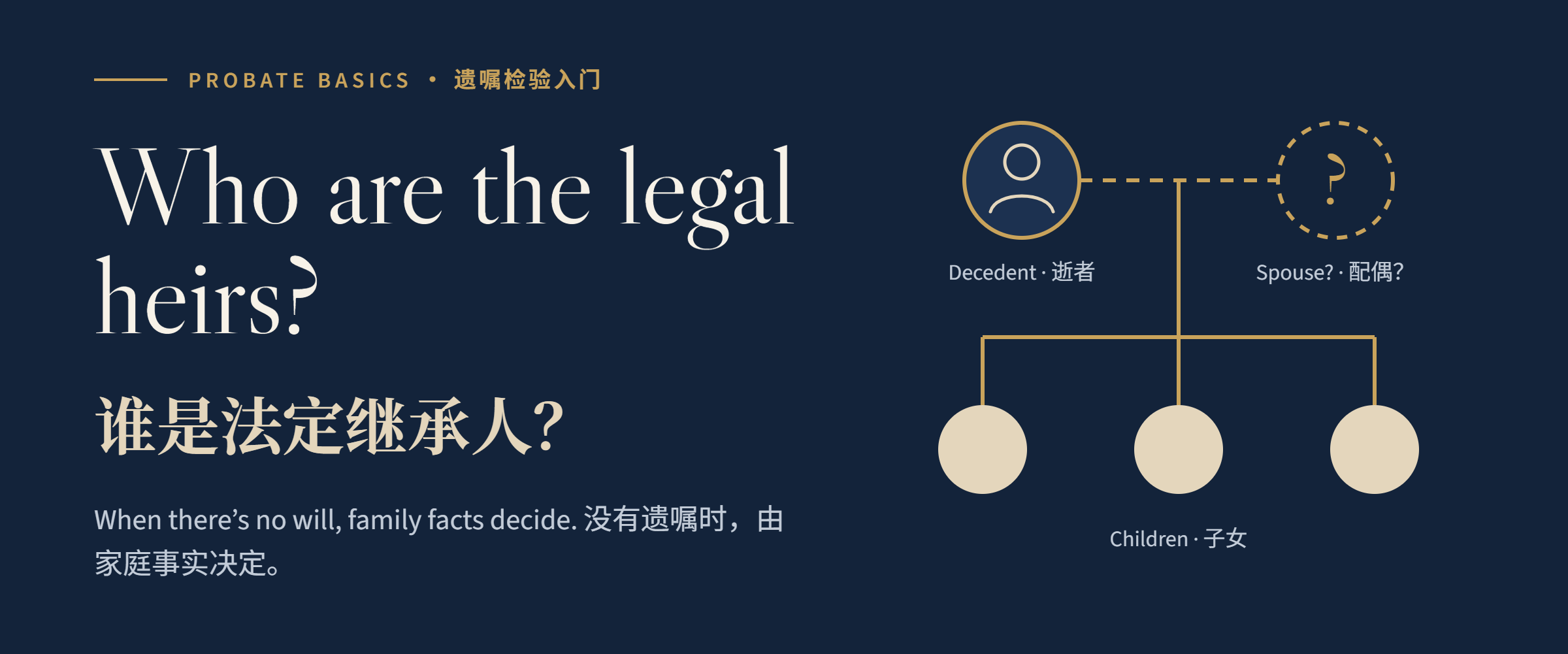
When someone dies without a will, Texas law decides who inherits. The answer isn't always obvious, and getting it wrong can cause problems for years. Here's a plain-language overview.
Who inherits depends on family facts
The Texas rules depend on whether the person was married, whether they had children, and whether each piece of property was community or separate. Some examples from the Dallas County Probate Court's guide:
- Married, all children from that marriage: if every child of the deceased is also a child of the surviving spouse, all of the deceased's community property goes to the spouse.
- Married, a child from another relationship: the deceased's share of the community property goes to the children instead. The surviving spouse keeps their own share.
- Separate personal property: the spouse receives one-third and the children share two-thirds.
So something as simple as a child from a prior relationship can change who receives the family home.
Two ways to establish who the heirs are
- Affidavit of heirship. This is a sworn statement of the family history, recorded in the county deed records. It doesn't involve a court hearing. Title companies commonly accept affidavits of heirship, but no law requires anyone to accept one. In Dallas County, it goes to the County Clerk's Recording Division, not the probate courts.
- Court determination of heirship. The probate court hears evidence and signs a judgment naming the heirs and their shares. The court must appoint an attorney ad litem to represent heirs whose names or locations are unknown. Under Texas law, anyone applying for a determination of heirship must be represented by a licensed attorney.
When a court case is usually needed
You'll usually need the court route in these situations:
- A missing heir. In Dallas County, if you don't know where an heir is, you cannot use a small estate affidavit and must file an application to determine heirship.
- Property no simpler method can transfer. The court route is the fallback when property can't be transferred with a small estate affidavit or an affidavit of heirship.
- Disagreement in the family about who the heirs are.
A real case: when a "former partner" is still a spouse
In Wilson v. Estate of Williams (Texas Court of Appeals, Waco, 2003), Derrick Williams died without a will in 1998. Years earlier, he and Loretta had lived together as an informally married couple. She testified that they agreed to marry, lived together, and told others they were husband and wife, and she backed that up with documents like canceled checks and medical records.
In 1994, Loretta moved out, and several months later she married another man in Oklahoma. After Derrick's death, she asked the court to declare her his surviving spouse.
The court found that the informal marriage had never ended in divorce. That meant her later marriage was void, and she was still Derrick's legal spouse and an heir when he died. The appeals court affirmed.
What families can take from this:
- An informal marriage is a real marriage. In Texas, a couple is informally married if they agreed to be married, lived together in Texas as spouses afterward, and represented to others that they were married.
- Separation doesn't end a marriage. Only a divorce (or a death) does. Someone who moved out years ago may still be a legal spouse and an heir.
- Gather the full family history before filing anything. That includes past relationships where a couple lived together and called each other husband or wife. An affidavit of heirship or a court application that leaves out a spouse can lead to disputes later.
Read the full opinion: [https://caselaw.findlaw.com/court/tx-court-of-appeals/1450607.html]
【中文】
亲人去世时没有遗嘱,便由德州法律决定谁来继承。答案往往不像想象中那么简单;一旦认定有误,可能造成多年的麻烦。以下用浅白的语言为您说明。
德州规则取决于逝者是否已婚、是否有子女,以及各项财产属于夫妻共同财产还是个人财产。以下例子摘自达拉斯县遗产法院的说明:
- 已婚,所有子女均出自这段婚姻:逝者的全部共同财产归在世配偶所有。
- 已婚,另有其他关系所生的子女:逝者那一半共同财产改由子女继承,在世配偶保留自己的一半。
- 个人动产:配偶分得三分之一,子女共分三分之二。
因此,仅仅是"前一段关系所生的孩子"这一事实,就可能改变家中房产的归属。
确认继承人的两种方式
- 继承人宣誓书(Affidavit of Heirship):记载家族情况的宣誓陈述,登记于县契据档案,无须开庭。产权公司通常接受,但法律并未要求任何人必须接受。在达拉斯县,此类文件须送交县书记官处的登记部门,而非遗产法院。
- 法院继承人认定(Determination of Heirship):遗产法院听取证据后作出判决,确认继承人及各自份额。法院会指派临时代理律师(attorney ad litem),代表姓名或下落不明的继承人。依德州法律,申请继承人认定须由执业律师代理。
通常需要走法院程序的情况
- 有继承人下落不明:在达拉斯县,这种情况下不能使用小额遗产宣誓书,须申请继承人认定。
- 其他简便方式无法转移财产:小额遗产宣誓书或继承人宣誓书都无法办理时,就需要走法院程序。
- 家人对继承人有争议。
真实案例:当"前任伴侣"仍是法定配偶
在 Wilson v. Estate of Williams(德州上诉法院,韦科,2003年)一案中,Derrick Williams 于1998年去世,未留遗嘱。多年前,他曾与 Loretta 以非正式婚姻(俗称普通法婚姻)方式共同生活。Loretta 作证称,两人同意结婚、共同生活,并对外以夫妻相称,还提交了已兑付支票、医疗记录等文件作为佐证。
1994年,Loretta 搬离两人的住所,数月后在俄克拉荷马州与另一名男子举行婚礼。Derrick 去世后,她请求法院认定自己为在世配偶。
法院认定,这段非正式婚姻从未以离婚方式解除,因此她后来的婚姻无效;Derrick 去世时,她仍是其法定配偶及合法继承人。上诉法院维持了这一判决。
这个案例给家庭的启示:
- 非正式婚姻同样是合法婚姻。 在德州,双方同意结婚、此后在德州以配偶身份共同生活,并对外表示已婚,即构成非正式婚姻。
- 分居不等于婚姻结束,只有离婚(或一方去世)才会终止婚姻。 多年前搬走的人,可能仍是法定配偶和继承人。
- 申请前务必完整整理家族资料。 包括过去曾同居、并以夫妻相称的关系。继承人宣誓书或法院申请如遗漏了配偶,日后可能引发争议。
判决书原文(英文):[https://caselaw.findlaw.com/court/tx-court-of-appeals/1450607.html]
DISCLAIMER
The information in this blog is provided for general educational and informational purposes only and is not intended as legal advice. Laws change frequently, and this content may not reflect the latest developments.
Viewing or reading this blog does not create an attorney-client relationship with Altaffer & Chen PLLC. You should consult a licensed attorney in your jurisdiction for advice tailored to your specific situation. Do not rely on this information to make legal decisions without professional guidance.
Neither Altaffer & Chen PLLC or Lunbing C. Altaffer makes any warranties regarding the accuracy or completeness of this content and expressly disclaims all liability for any reliance on it.
10/2/2026
Contact Information:

4054 McKinney Ave
Suite 310
Dallas, TX 75204
Tel: (972) 234 3633
Fax: (972) 947 3663
Email: info@altafferlaw.com
WeChat ID: altafferchen